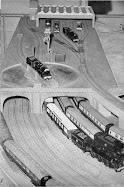
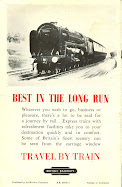
A tour around some Hornby Dublo catalogues from the 1930s, 1940s and 1960s.
Monday, February 23, 2009


Thursday, February 19, 2009
Two Moguls on the Lickey Incline
The Stanier Mogul and Collett Mogul made history in November 1997 when they became the first steam locos to climb the Lickey Incline for 31 years.
2968 and 7325 on the Lickey Incline
2968 and 7325 on the Lickey Incline
Sunday, January 25, 2009
Whatever happened to this model railway?
 In 1948 British Railways' specialist staff of The Railway Executive Publicity department assembled a Gauge 'O' model railway, with many other departments of British Railways helping to make the model as authentic as possible. The following information and pictures are taken from publicity booklets that were published in the 1950s. The layout and its rolling stock were, it is assumed sold off or disposed of many years ago.
Following its first appearance in 1948 the model was a feature of many exhibitions throughout the country, including the Daily Mail Ideal Home Exhibition and in Department Stores.
The text in the following paragraphs is copied straight from the leaflet
It is assumed that most of the locomotives and rolling stock were from Bassett Lowke. If anyone has any knowledge of where these models eventually found a home please comment.
LAYOUT
Normally measuring 30 ft. by 15 ft. (40 ft. by 21 ft., with the surrounding stand), the model railway is portable. Each table section, which measures 6 ft. by 3 ft., is mounted on independently adjustable legs to give a normal height of 2 ft. 9 in.
It is assumed that most of the locomotives and rolling stock were from Bassett Lowke. If anyone has any knowledge of where these models eventually found a home please comment.
LAYOUT
Normally measuring 30 ft. by 15 ft. (40 ft. by 21 ft., with the surrounding stand), the model railway is portable. Each table section, which
 measures 6 ft. by 3 ft., is mounted on independently adjustable legs to give a normal height of 2 ft. 9 in.
The model was so designed and constructed that it could be assembled and dismantled in the shortest possible time, and this has imposed certain limitations on its scenic background. Thus the scenery is made of flexible material and the joints in the embankment are masked by small strips fashioned to resemble stone drainage.
TRACK
On a railway of this kind the track must be very strong and, at the same time, built to scale. The" Three Rail" system was adopted to allow metal sleepers to be used. These have embossed rail plates and carry the latest type of flat bottom rail to a scale length of 60 feet. They are fastened to a ballasted strip which, in turn, is fixed to the baseboards, giving the best possible appearance of a correctly ballasted track. The embankments are constructed with timber foundation and gradients are approximately 1 in 50. The bridges are replicas of types now in use.
SIGNALS
The layout is accurately signalled, in accordance with full size practice, both colourlight and semaphore signals being used. The railway is on view for weeks at a time and it has, for this reason, been found impracticable to keep signal lights burning as the life of electric bulbs is too short and replacements difficult. The semaphore signals are operated individually from the control panel.
ELECTRIC WIRING
Coloured and numbered plug and socket joints assist in the rapid assembly of the electric wiring installation which is carried on the underside of the tables. A flexible insulated wire is used to prevent breakages which are liable to occur through vibration in transit. A common return circuit is provided under each· table by a copper bar with a flexible connection to its neighbour, and this is tapped along its length to allow connections to be made thereto.
The locomotives work on 20 volt D.C., the current being supplied from A.C. mains through rectifiers. The D.e. current is fed to the control panel through two 12-volt 36-watt bulbs which act as fuses.
CONTROL
CONTROL
The control box has six separate panels, each equipped with stud type resistance, 12 sections and eight point levers. The number of panels in use depends upon the design of the layout to be worked.
Five panels are used to operate the layout shown on centre pages, divided as follows :-
Five panels are used to operate the layout shown on centre pages, divided as follows :-
(1) Up Main Line and Sidings.
(2) Down Main Line and Sidings.
(3) Goods Line.
(4) Locomotive Shed Roads.
(5) Goods Sidings.
Each line is split up into sections, the division being made in the most convenient place for operating purposes.
(2) Down Main Line and Sidings.
(3) Goods Line.
(4) Locomotive Shed Roads.
(5) Goods Sidings.
Each line is split up into sections, the division being made in the most convenient place for operating purposes.
All points are operated by double solenoid point motors working on 20 volt A.C. Points are normally set for the main line and an automatic lock holds the point in position after the blades have been moved.
The locomotives are operated through a stud-type resistance.
When the handle is at 90° on the quadrant no current is passing to the locomotive which is stationary. To start the train moving, the handle is brought slowly round in a clockwise direction from one stud to the next. The first stud allows only a small amount of current to flow and the locomotive starts moving forward. The next stud increases the current and thus the speed. The movement from one stud to another continues until the locomotive has attained a full scale speed.
The action is reversed back to 90° to stop the locomotive. As the current supply is reduced so the speed decreases until the locomotive is stationary.
Movement of the locomotive in the reverse direction is obtained by reversing the current to the locomotive which is automatically brought about by moving the handle from the 90° position in an anticlockwise direction-the opposite way to that which produced the forward movement.
POINTS (OR SWITCHES)
Movement of the locomotive in the reverse direction is obtained by reversing the current to the locomotive which is automatically brought about by moving the handle from the 90° position in an anticlockwise direction-the opposite way to that which produced the forward movement.
POINTS (OR SWITCHES)
Points are operated by drawing the appropriate lever forward when a passing electrical contact is made which energises one of the solenoids and the point blade is moved over. When the lever is moved back a similar contact is made which energises the other solenoid and the point blade moves in the reverse direction.
OPERATION
OPERATION
It is possible to have 2 passenger trains running, each on its own circuit, also a freight train on the goods line. An automatic coupling and uncoupling device enables a freight train to be made up or put away in the goods sidings or a passenger train to be drawn from or stabled in 2 passenger sidings.
LOCOMOTIV ES
LOCOMOTIV
 ES
The types now in use on this model are as under :
BR. Standard Class 7 Loco. 70000.
B.R. Standard Class 5 Loco. 73001.
L.M.Region
Pacific," Sir William Stanier."
10,000 Class Diesel.
6P Class.
2-6-2 Tank.
Western Region
King Class.
1,000 Class.
Pannier Tank.
Eastern Region
Pacific, " A. H. Peppercorn."
B1. Class.
L.I. Class Tank.
Southern Region
Pacific, Merchant Navy Class.
Schools Class.
Diesel Shunting Locomotive.
(These are being added to as required.)
ROLLING STOCK
The rolling stock at present in use consists of the following vehicles :-
Passenger.
Train of six Main Line Express passenger coaches representing " The Royal Scot " (L.M.R.).
Train of six Main Line Express passenger coaches representing the" Cornish Riviera Express" (W.R.).
Train of six Main Line Express passenger coaches representing " The Flying Scotsman" (E.R.).
Train of six Main Line Express passenger coaches representing " The Atlantic Coast Express" (S.R.).
Pullman Train, including observation car. Train of five Suburban steam train coaches.
Four-coach set of Main Line electric stock (S.R.). Two-coach set of Suburban electric stock (S.R.).
Horse Box.
Freight.
Ten 10-ton open wagons.
Ten 12-ton open wagons.
Three flat wagons with containers.
Eight covered vans (various types).
One six-wheeled milk churn van.
Three 8-wheeled flat wagons. One brick wagon.
One tar wagon.
One cattle truck.
Three brake vans.

Saturday, December 27, 2008
Wolverhampton Steam Shed 1967
See links for the Youtube version of Nick Hedge's men and steam photographs taken in 1966 and 1967 at Wolverhampton Oxley shed
Sunday, October 26, 2008
Gloucester Warwickshire Railway
If you are visiting the GWR steam and diesel heritage railway in the Cotswolds at Toddington over a weekend or for a few days a good place to stay for luxury bed and breakfast is the West Wing Abbey Manor just on the edge of Evesham. See http://westwingabbeymanor.blogspot.com/
From here you can explore many parts of the Cotswolds and don't forget to visit the Winchcombe Railway Museum for a really different railway heritage experience.The GWR has a station in the village. For the followers of the Turf there is also the GWR's Cheltenham Racecourse Station
In addition to a scheduled service, the GWR hosts a number of galas, enthusiasts’ events and events for all the family throughout the year, including Santa Specials, Paddington Bear, Fish and Chips specials and dining trains.
Friday, September 26, 2008
Working the Lickey Incline
Notes from the SLS Midlands Forum April 2008 on working the Lickey Incline
In steam days virtually all of the up (South West to North East) trains had to stop at Bromsgrove for a banking engine. Then as now the chief horror to be avoided was stopping - "if you stop, you stick". A modern HST can rush the Lickey but physics still plays its part and while it may hit Bromsgrove at 110 mph by the time it gets to Blackwell it's down to 88 mphDescending the Lickey with unfitted goods and mineral trains was a nightmare and about half of all trains were probably out of control by the time they reached the Bromsgrove.Heavy braking led to a blue haze from overheated brake blocks and in diesel days' fears that the red hot blocks would set fire to congealed grease and oil on the engine bogiesTwo frightening incidents were a driverless 47 taking its rake of wagons and guard's van containing a traumatised guard downhill. In steam days an Austerity ran out of control, was diverted into the platform road at Bromsgrove, where it hit the points so hard that it fell off the rails but fortunately regained them.The locos remembered from steam days as working up and down the Lickey and banking were:
- Norris 4-2-0sClass
- 9F 2-10-0s
- Stanier 8F 2-8-0s
- Austerity 2-8-0s
- Midland Compounds
- 'Jinty' 0-6-0s
- GWR 2-8-0T and 0-6-0 PTs
- Big Bertha - 0-10-0s
- Jubilees
- Royal Scots
- Black Fives
- Hughes' Crabs 2-6-0s
The Bromsgrove footplatemen preferred the GWR panniers tanks to the 'Jinties'
Acknowledgements to Stephenson Locomotive Society.
For a full report on this seminar see the 2009 SLS Centenary Book to be published next year
Friday, August 29, 2008
James Cholmeley Russell
Read the biography of James Cholmeley Russell at http://jamescholmeleyrussell.blogspot.com/, a key and controversial figure in the development and life of the North Wales Narrow Gauge Railways Company that later became the Welsh Highland Railway. The original article was published in the Welsh Highland Heritage Society Journal but new material on his life is gradually emerging.
Wednesday, August 27, 2008
Hornby Dublo Catalogue

Introductory page from 1950s Hornby Dublo model railway catalogue showing controller, couplings and electric signals and points. Note the very non PC smoking father!
Tuesday, August 26, 2008
Hornby Dublo Book of Trains

Brilliant combination of the art of the photographer and the skill of the studio artist
Produced in 1959 for the launch of the Hornby Dublo 2 rail model railway range, some of it based on the old 3 rail range but many new products particularly the plastic injection moulded SD range of railway wagons
Hornby Dublo 1950s catalogue

The Classic 3 rail Hornby Dublo model railway multi folded catalogue leaflet. Duchess of Montrose at the head of "blood and custard" tin plate coaches about to leave the wonderful die cast Hornby Dublo station buildings. Passengers are those handpainted lead figures that are now so collectible.


Tri-ang Railways 1963 Cuneo Cover

Cuneo was Tri-ang 's favourite artist for a while in the 60s. And did stuff for Gamages Toy Catalogue as well! Great picture with lots of allegorical overtones - the old and the new, the changeover, late 20th century technology versus early 20th century technology, romance versus modern technology, the triumph of man over the elements - Brunel died very shortly after the bridge opened etc...And where is Cuneos's mouse?
And who owns the original of this great picture now?
And all for a toy/model railway catalogue!
Clifton Rocks Railway - funicular

What it used to be like - catch a tram along the Avon Gorge and then catch the Clifton Rocks Railway and have tea in the Grand Spa (now Avon Gorge Hotel)
Clifton Rocks Railway
Just added link to Clifton Rocks Railway restoration project. Richard Webster and I jokingly discussed this in the 1980s - now it might happen!
Monday, August 25, 2008
Steam Index
I've just added a new link for Steam Index which is a fantastic resource for any one interested in steam locomotive history and railways - it has bibliography, magazines, abstracts, patents, indexes, patents and biography.
All it seems by one man Kevin Jones - born at about the same time as the A4 Pacifics!
All it seems by one man Kevin Jones - born at about the same time as the A4 Pacifics!
Wolverhampton Steam Shed 1967

53-23 Group of railway men, last days of steam at Wolverhampton1967, originally uploaded by Boxbrownie3.
Where are they all now? Fanatastic group of guys taken by Nick Hedges. More on Flickr at BoxBrownie 3
Fireman shovelling coal, Wolverhampton 1967

Part of a series taken by the wonderful photographer Nick Hedges of the last days of steam at Wolverhampton Shed


Subscribe to:
Posts (Atom)


 Posts